If you’re building through-hole boards, radial electrolytic capacitors are usually installed in one of two ways: vertical (standing) or horizontal (lying down). Picking the right forming style isn’t just “how it looks”—it affects board space, height clearance, wave-solder yield, and mechanical strength.
This guide keeps it practical: what it is, why it matters, and how to choose, plus the most common size standards you’ll see on production lines.
What “vertical” and “horizontal” forming actually mean
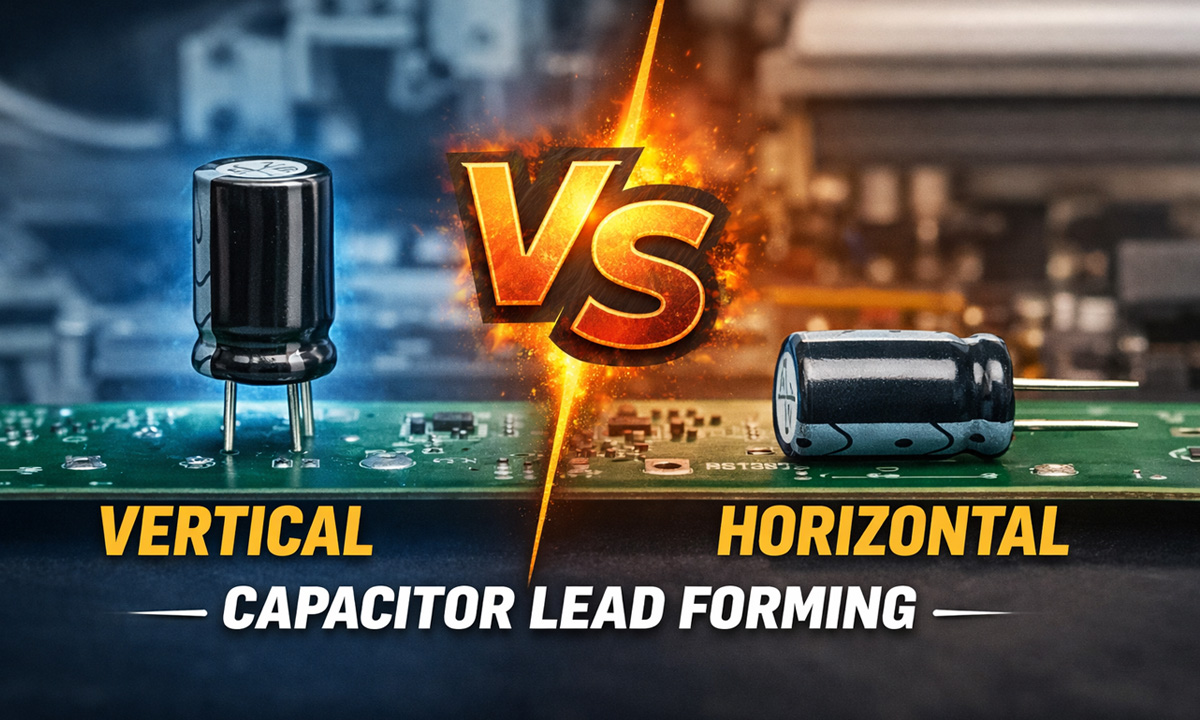
Vertical (standing) forming
The capacitor body stands upright on the PCB. Leads are formed to match the hole spacing, usually with a straight drop and a small lead set for stability.
Best for: saving board area.
Horizontal (lying down) forming
The capacitor body lies parallel to the PCB. Leads are bent so the can sits low and stable, often with a longer formed shape.
Best for: lower height + better mechanical stability.
Why the forming choice matters in real production
- Board footprint vs height
- Vertical saves footprint.
- Horizontal reduces height and often improves vibration resistance.
- Wave solder quality
- Consistent lead length + lead pitch = cleaner solder fillets and fewer bridges.
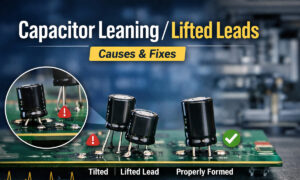
- Bad forming = uneven lead protrusion, tilted parts, and solder defects.
- Assembly efficiency
- Bulk capacitors need repeatable forming to feed smoothly into insertion, fixture plates, or manual insertion.
- Reliability
- Horizontal mounting usually handles shipping shock and vibration better.
- Vertical mounting can be fine, but needs correct lead length and support when the can is tall/heavy.
When to choose vertical forming
Choose vertical if you have one (or more) of these conditions:
- PCB space is tight
- Power supplies and dense boards often prefer standing caps.
- Height is not a strict limit
- If you’re not fighting enclosure clearance, vertical is the easy win.
- Cap is not overly tall/heavy
- Small to mid-size cans are common vertical candidates.
👉 If you’re setting up a line for stable, repeatable standing-lead output, use a dedicated vertical lead forming machine:
Capacitor Vertical Lead Forming Machine (Internal Link): https://flourishe.net/proudt/electronic-component-lead-forming-machine/radial-lead-forming-machines/
When to choose horizontal forming
Choose horizontal if:
- You have strict height clearance
- Enclosures, adapters, low-profile products, and stacked boards.
- Your product sees vibration / drop / transport abuse
- Horizontal mounting typically gives a lower center of gravity and better support.
- You want “easier” mechanical stability
- Especially for larger can sizes.
👉 For production-grade lying-down output, use a dedicated horizontal lead forming machine:
Capacitor Horizontal Lead Forming Machine (Internal Link): https://flourishe.net/product/fl-809-automatic-bulk-radial-capacitor-lead-forming-machine/
Common size standards you’ll see
In capacitor forming, most factories care about three dimensions:
1) Lead pitch (hole spacing)
This is the PCB hole-to-hole distance. The most common radial electrolytic pitches are:
- 2.0 mm
- 2.5 mm
- 3.5 mm
- 5.0 mm
- 7.5 mm
- 10.0 mm
How to use it: match your forming tooling to your PCB pitch. If pitch is off, insertion becomes painful and you’ll get tilt or stress.
2) Lead cut length (lead protrusion after insertion)
Most wave-solder lines want a controlled protrusion so the solder joint forms correctly.
Typical targets you’ll hear on the floor:
- About 1.0–2.0 mm lead protrusion on the solder side (varies by board thickness and process)
Rule of thumb: keep it consistent. Consistency beats “perfect” on paper.
3) Body clearance for horizontal forming
For horizontal forming, you usually define:
- Body-to-PCB standoff (slight lift helps flux flow and cleaning)
- Overall height limit (the whole point of lying down)
Factories often standardize a few “lying height” setups depending on product family.
Quick decision checklist
Pick Vertical if:
- You need smaller footprint
- Height is okay
- The capacitor is not huge/tall
- Your biggest pain is board crowding
Pick Horizontal if:
- You have height limits
- You want more stability for shipping/vibration
- You’re dealing with larger cans
- You want fewer issues from parts leaning/tilting
Practical tip: don’t guess—standardize by product family
A smart approach is to set a company standard like:
- Family A (compact chargers): vertical, pitch 2.5/3.5/5.0
- Family B (low-profile/industrial): horizontal, controlled lying height + stable lead length
That alone usually improves yield because operators stop “freehand forming.”