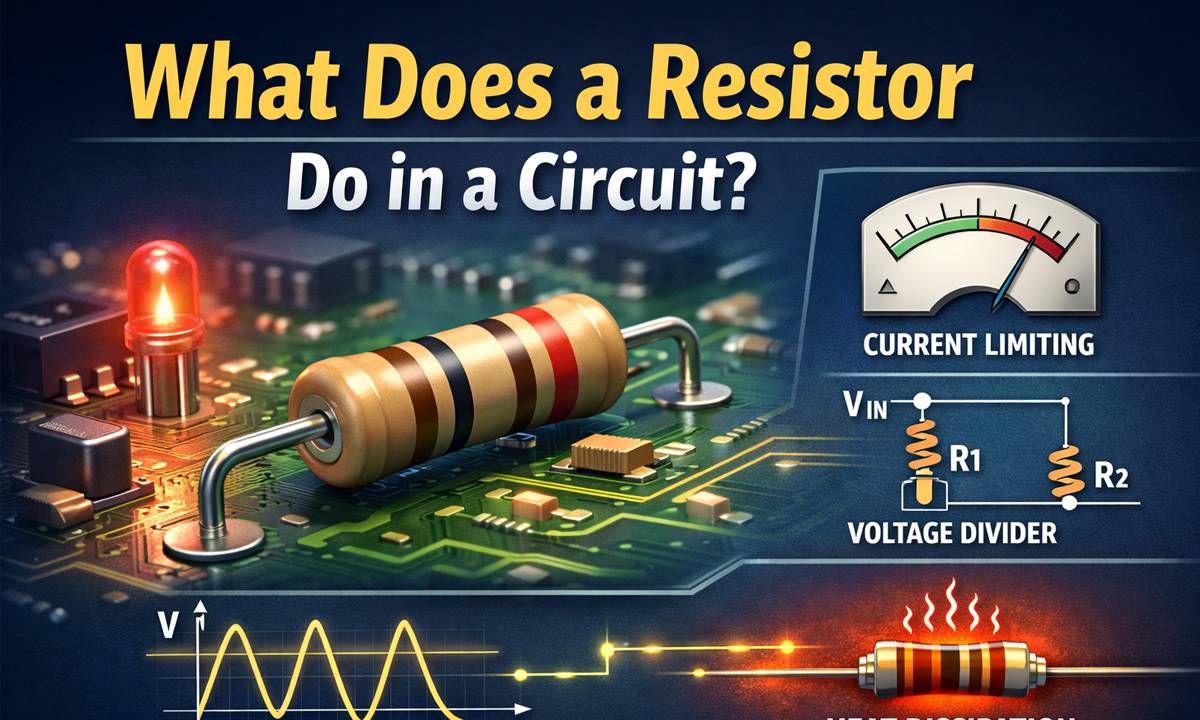
A resistor is a component that opposes current flow. By doing that, it controls voltage and current in predictable ways—protecting parts, setting signal levels, and turning electrical energy into heat when needed.
The core job: control current and voltage
- Limit current (protect LEDs, IC pins, transistors).
- Drop voltage across a component or section of a circuit.
- Set operating points (biasing in analog stages and transistor circuits).
Common ways resistors are used
1) Current limiting (protection)
Put a resistor in series to keep current from exceeding what a device can safely handle (classic example: LEDs, gate/base resistors).
2) Voltage dividers (create a reference voltage)
Two resistors in series can “divide” a voltage into a smaller, stable voltage for sensing, feedback, or ADC inputs.
3) Pull-up / pull-down (define logic states)
Resistors keep digital inputs from floating, reducing random toggles and noise sensitivity.
4) Feedback and gain setting (analog & power circuits)
In op-amps, regulators, and DC-DC converters, resistor networks set gain, output voltage, or control-loop behavior.
5) Sensing current (measurement)
A low-value “shunt” resistor lets the circuit measure current by reading the tiny voltage across it.
6) Timing (RC networks)
With capacitors, resistors create delays, filters, and time constants used in soft-start, debounce, and signal conditioning.
7) Heat / energy dissipation (intentional power loss)
Sometimes you want a resistor to safely burn off energy (bleeder resistors, snubbers, discharge paths).
How to choose the right resistor (the specs that matter)
Picking “the right ohms” is only step one. In real products, these parameters decide reliability:
- Resistance value (Ω) and tolerance (±1%, ±5%).
- Power rating (W) — how much heat it can dissipate continuously.
- Voltage rating — important in high-voltage designs.
- Temperature coefficient (TCR) — stability across temperature changes.
- Pulse/surge capability — for inrush, spikes, snubbers, and transient events.
- Package / size — impacts thermal performance and assembly.
If you want a practical checklist for reading datasheets and choosing specs for real production (not just theory), use this: electronic component parameter selection guide.
Manufacturing note: why resistor lead forming matters
In through-hole production, the resistor’s electrical role is only half the story. If lead length or bend shape is inconsistent, you’ll see:
- hard insertion, bent leads, or damaged bodies
- uneven standoff height (stress on solder joints)
- wave-solder defects and rework
To standardize cut length and bend geometry at scale, many lines use a dedicated resistor lead forming machine.
Quick FAQ
- Do resistors “use up” voltage? No—voltage is a difference in potential. A resistor causes a voltage drop when current flows.
- Why do resistors get hot? Power turns into heat: P = I²R (or P = V²/R). If P exceeds the rating, overheating happens.
- Can I replace a resistor with a different wattage? Usually yes if the resistance value matches—higher wattage is typically safer (bigger, cooler).