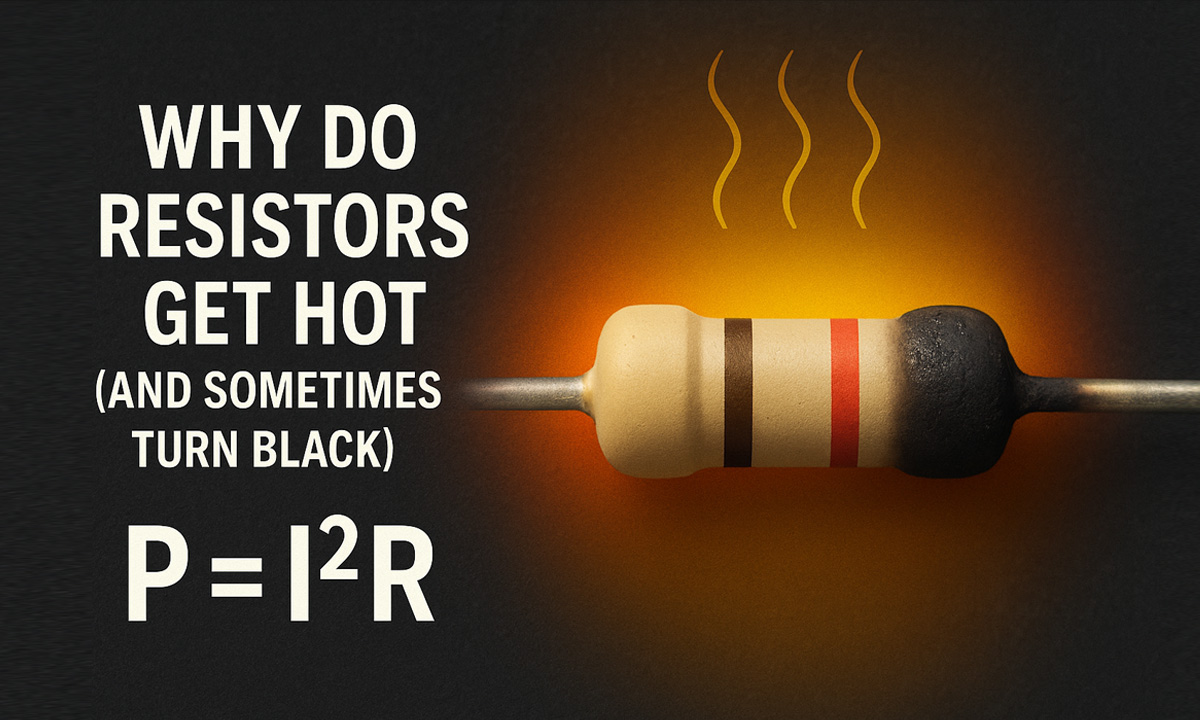
A resistor turns electrical energy into heat on purpose. But when the heat can’t escape fast enough—or the resistor is asked to dissipate more power than it’s designed for—its coating can discolor, crack, smoke, or char the PCB around it. The root cause is almost always excess power dissipation plus insufficient thermal margin (power rating + derating + airflow + mounting).
The physics in one line: power becomes heat
The heat a resistor generates is its power dissipation:
- P = I²R (current-driven)
- P = V²/R (voltage-driven)
If you double the current, heat goes up by 4× (because of I²). That’s why a “slightly higher current” in a fault condition can quickly push a resistor into overheating.
The most common reasons a resistor overheats or burns black are
1) The resistor is simply undersized for the real dissipation
Many circuits “work” electrically while the resistor is silently running beyond its safe thermal limits. This happens a lot in:
- Bleeder resistors across high voltage rails
- Droppers in linear supplies
- Inrush limiting resistors
- Snubbers / damping networks
- Fault paths during short circuits
Fix: choose a higher wattage part, split into series/parallel resistors, or change topology (e.g., use a regulator instead of a dropper).
2) Derating was ignored (ambient temperature matters)
Most resistor power ratings assume a specific environment, commonly 70°C ambient with derating above that. Datasheets typically show a derating curve where allowable power falls as ambient or terminal temperature rises.
Here’s a typical linear derating example used by many resistor families (full power at 70°C, down to 0% at 155°C):
| Ambient (°C) | Allowable Power (% of rated) |
|---|---|
| 70 | 100% |
| 85 | 82% |
| 100 | 65% |
| 125 | 35% |
| 155 | 0% |
What this means: a “1 W” resistor might only be effectively “0.65 W” at 100°C ambient.
3) Surge/pulse / inrush energy is overheating the element
Even if average power looks safe, pulses (switch-on inrush, lightning surge simulation, repetitive bursts) can exceed the resistor’s pulse-energy capability and damage the film/coil. App notes and safety-resistor datasheets often discuss surge waveforms and fusing behavior.
Fix: use a resistor specified for pulse/surge or a fusible/flameproof safety resistor where appropriate.
4) A “flameproof” resistor still gets dangerously hot near overload
A flameproof/fusible resistor is designed to reduce fire risk and fail safely, not to stay cool under abuse. Under some overload conditions, the body can still reach temperatures high enough to ignite nearby plastics or scorch the PCB if spacing and standoff are poor. ttelectronics.com
Fix: keep clearance, use proper PCB standoff, and don’t rely on “flameproof” as a substitute for proper power design.
5) Bad mounting and heat trapping (PCB scorching, poor airflow, wrong spacing)
Resistor temperature is strongly affected by how it’s mounted:
- Leads bent too close to the body (less convection, more heat into PCB)
- Resistor body touching the PCB (scorching risk)
- Crowded layout near hot parts (MOSFETs, transformers, heatsinks)
A practical guideline from a fusible resistor application note: keep solder joints a few mm away from the body, maintain clearance from combustibles, and use lead forming to create PCB standoff to prevent scorching.
A quick troubleshooting checklist (what to measure)
- Compute dissipation with real operating values (and worst-case tolerances).
- Compare to the derated rating (ambient + enclosure + airflow).
- Check fault conditions: short circuits, startup, load dump, brownout recovery.
- Measure actual temperature (IR thermometer/thermocouple).
- Inspect for PCB darkening: that’s a sign of sustained high temperature, not just a brief spike.
Reliability rule of thumb: don’t design right on the limit
High-reliability derating guidance commonly recommends operating resistors at a fraction of rated stress (often ~50% power depending on style and mission profile).
Even commercial designs benefit from margin because airflow, enclosure temperature, and real-world tolerances are rarely “datasheet perfect.”
Design fixes that actually stop resistors from burning
Choose the right resistor technology
- Metal film / thick film: general-purpose, limited surge
- Wirewound: better for power/energy, often larger and cooler
- Fusible/safety resistor: safer failure mode for mains/input protection
Improve thermal layout
- Add spacing around the resistor
- Keep away from plastics/connectors
- Increase copper area if the design allows (for SMD power resistors)
- Avoid trapping it under shields or foam
Use lead forming for standoff (through-hole)
Standoff reduces PCB scorching risk and improves convection cooling.
If you’re optimizing through-hole resistor assembly and consistent standoff/lead geometry, see:
- Essential Equipment List for Resistor Lead Cutting and Forming
- FL-612 High-Precision Resistor Horizontal & Vertical Integrated Forming Machine
FAQ
Can a resistor “burn black” even if the circuit still works?
Yes. Electrical function can remain while the coating and nearby PCB slowly char due to long-term overheating.
Is blackening more likely in enclosed products?
Absolutely. Enclosures raise ambient temperature and reduce airflow, which increases the need for derating. seielect.com+1
If I switch to a flameproof resistor, am I safe?
It reduces fire risk, but it can still get hot enough to damage nearby materials if spacing/standoff are wrong or overload is su