
If you’re searching “How much does an LED component lead forming machine cost?” you’re usually trying to answer two things:
- What’s a realistic budget range for my production needs?
- What specs do I need to send a supplier so the quote is accurate (and comparable)?
This guide breaks down the 10 biggest price drivers and ends with a configuration checklist you can copy-paste into your RFQ.
If you’re specifically forming DIP LEDs and other axial-lead parts, start here: Axial Lead Forming Machines.
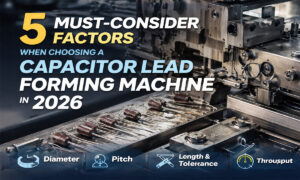
And if your line also handles capacitors, you’ll want this selection guide (it helps you avoid buying a “fast” machine that doesn’t match your tolerances): 5 Must-Consider Factors When Choosing a Capacitor Lead Forming Machine in 2026.
Typical Price Ranges (What Most Buyers See)
Pricing varies by spec, but most projects fall into these practical tiers:
- Entry / Basic forming & cutting (semi-auto): best for stable, single-shape production and modest tolerance requirements
- Mid-range production system: better stability, faster changeover, more forming options, sensor upgrades
- High-end / automation-ready: maximum repeatability, high throughput, complex forming, feeding integration, QC/traceability options
Instead of guessing a number, treat cost as the outcome of your tolerance + throughput + automation requirements. The 10 factors below explain exactly why.
The 10 Factors That Most Affect LED Forming Machine Price
1) Your Target Lead Pitch, Lead Length, and Tolerance
This is the #1 driver.
- Wider tolerances allow simpler tooling and fewer compensation features.
- Tight tolerances require higher rigidity, better guides, precision tooling, and often sensors/feedback.
What to specify:
- Lead pitch (e.g., “to PCB hole pitch”)
- Final lead length (after cut)
- Acceptable tolerance band (your real pass/fail spec)
2) Forming Shape Complexity (Straight, 90°, U-Form, Kink, Custom)
A machine that only does one common shape is usually far cheaper than one that supports multiple forms.
Common LED/axial forms include:
- Straight cut to length
- 90° bend (single or double)
- U-form / stand-off
- Kink / stress relief forms
- Custom geometry to match unique PCB fixtures
Each additional forming style typically means additional tooling, changeover parts, or more complex mechanism control—raising price.
3) Component Size Range and Compatibility (One Part vs Many)
If you run just one LED body size and lead diameter all year, your quote will look very different than a factory running multiple sizes.
Key specs that affect mechanical design and tooling:
- Lead diameter range
- Component body diameter/length (and lead span)
- Material hardness/finish (affects wear and tooling life)
Wider compatibility usually means:
- More adjustable fixtures
- More robust guiding
- More change parts and calibration points
4) Throughput Requirement (Parts/Hour) and Duty Cycle
When you ask for higher throughput, the system must handle:
- Stronger drives and more rigid frames
- Better heat management and wear resistance
- Improved stability at speed (vibration control)
Also clarify duty cycle:
- “8 hours/day single shift” vs “24/7” changes what “industrial grade” means in the build.
5) Feeding Method (Loose Bulk, Tube, Tape & Reel, Magazine)
Feeding is one of the fastest ways to change the quote.
Examples:
- Manual/assisted loading: lower cost, higher labor
- Tube/magazine feeding: more consistent, moderate cost
- Tape & reel integration: higher cost but improves automation compatibility
- Vibratory/bowl or special feeders: higher customization cost
If you’re not sure, many buyers start with a solid base forming machine and plan feeder upgrades after confirming demand.
6) Changeover Speed and “Small-Batch Friendliness”
If your production is “few SKUs, high volume,” you can tolerate longer changeovers.
If your reality is “many SKUs, small batches,” you’ll pay for:
- Quick-change tooling
- Scales/position indicators
- Repeatable settings (and sometimes memory/recipes depending on system)
This factor is often underestimated—and it directly impacts the true ROI.
7) Tooling Quality, Tooling Quantity, and Spare Tool Sets
Tooling isn’t just a one-time accessory. It’s part of your ongoing operating cost—and it changes the initial quote.
Pricing increases with:
- Higher-grade tool steel
- Coatings for wear reduction
- Extra tool sets for different forms/specs
- Spare knives and critical wear parts
Ask your supplier what’s included in the “standard tooling package” vs optional.
8) Sensors, Detection, and Quality Control Options
Adding sensors can raise upfront cost, but it often saves far more by reducing defects and rework.
Common upgrades:
- Part presence detection
- Jam detection and auto stop
- Cut length verification (sampling or inline, depending on design)
- Counting, batching, and reject handling
If your biggest pain is “inconsistent lead length” or “mysterious scrap spikes,” sensor upgrades can be worth it.
9) Build Quality and Mechanical Design (Rigidity, Guides, Bearings)
Two machines can “do the same forming shape,” but one holds tolerance longer under load and speed.
Price tends to increase with:
- More rigid frame and precision guide rails
- Higher-quality bearings and motion components
- Better alignment retention (reduces drift and frequent re-tuning)
If your line can’t afford downtime, build quality is not optional—it’s your insurance policy.
10) After-Sales, Spares Availability, Training, and Warranty Scope
This is where “cheap” can become expensive.
A more complete package may include:
- Commissioning and training
- Spare parts kit
- Faster support response
- Longer warranty or clearer coverage terms
If this machine sits on a critical path, factor support into your cost model—not just the purchase price.
Configuration Checklist (Copy-Paste Into Your Quote Request)
Send this to your supplier to get a fast, accurate quote:
Part information
- Component type: DIP LED / axial lead component
- Body size (diameter/length): ___
- Lead diameter range: ___
- Lead material/finish: ___
Forming requirements
- Final lead pitch: ___
- Final lead length (after cut): ___
- Tolerance requirement (pitch/length/angle): ___
- Forming shape: Straight / 90° / U-form / kink / custom (attach drawing if custom)
Production targets
- Target throughput (pcs/hour): ___
- Working schedule: 1 shift / 2 shifts / 24/7
- Expected changeover frequency: ___ SKUs per week/month
Feeding & output
- Feeding: manual / tube / magazine / tape & reel / other
- Output: tray / bin / conveyor / counted batching
- Need counting/batching? yes/no
Quality & safety
- Sensors: part-presence / jam detection / count / length check
- Power: voltage/frequency standard
- Safety requirements (if any): ___
Extras
- Tooling sets needed: ___
- Spare wear parts kit: yes/no
- On-site installation & training: yes/no
How to Compare Quotes Fairly (Quick Tip)
When you receive multiple quotes, compare these three items line-by-line:
- Included tooling package (how many sets? what materials?)
- Supported tolerance at your target speed
- Changeover method and included change parts
This prevents “lowest quote wins” from turning into “highest downtime loses.”
FAQ
Does a higher price always mean better precision?
Not always—but precision at high speed typically requires stronger mechanical design, better guides, and higher-quality tooling, which increases cost.
What’s the most common reason quotes vary wildly between suppliers?
Missing specs: tolerance, feeding method, and forming complexity. If those aren’t defined, suppliers are quoting different machines.
If I also produce capacitors, do I need a separate selection guide?
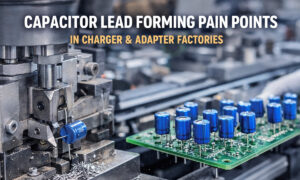
Yes. Capacitor lead forming often has different constraints (lead spacing, lead hardness, body stability, and downstream insertion). Use this guide to choose correctly: Capacitor Lead Forming Machine Selection Factors (2026).