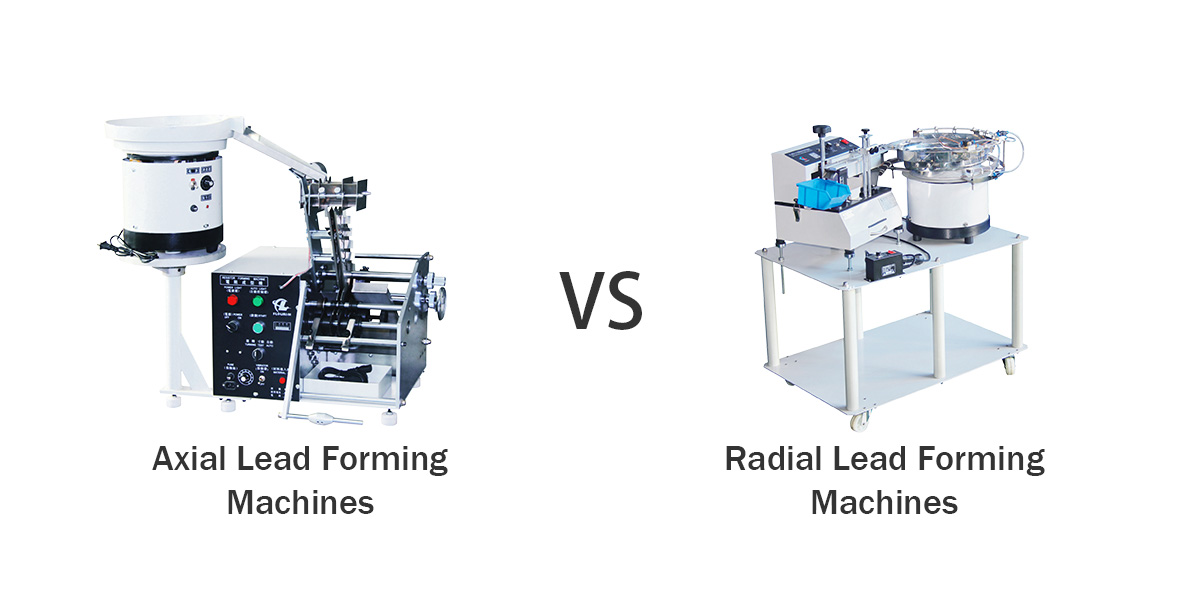
In the electronics manufacturing industry, resistor forming machines and capacitor lead cutting machines are two common types of automation equipment. While they differ in structure and application, both play an important role in improving efficiency, ensuring consistency, and reducing production costs. This article compares these two machines in terms of function, application scenarios, price, and selection tips to help you quickly identify the most suitable solution.
What Is a Resistor Forming Machine?
A resistor forming machine is mainly used to cut and bend the leads of axial components such as resistors, diodes, and capacitors into specific shapes, including vertical, horizontal, or gull-wing forms. It is widely applied in power adapters, household appliance control boards, automotive electronics, and industrial power supplies, ensuring components can be smoothly inserted into PCBs and meet process requirements.
👉 For more details, see our in-depth guide: Resistor Forming Machine Selection Guide.
What Is a Capacitor Lead Cutting Machine?
A capacitor lead cutting machine is designed specifically for electrolytic capacitors and similar components. Using precision blades, it trims the leads to a uniform length. This process is commonly used in the production of chargers, LED drivers, industrial power supplies, and new energy equipment. Standardized lead lengths not only improve soldering reliability but also significantly enhance assembly efficiency.
👉 For more details, see our in-depth guide: Capacitor Lead Cutting Machine Selection Guide.
Resistor Forming Machine vs Capacitor Lead Cutting Machine: Key Differences
| Comparison | Resistor Forming Machine | Capacitor Lead Cutting Machine |
|---|---|---|
| Main Function | Cutting + lead bending | Fixed-length cutting |
| Suitable Components | Resistors, diodes, small capacitors (axial components) | Electrolytic capacitors |
| Typical Process | Vertical, horizontal, gull-wing forming | Lead length trimming |
| Applications | Control boards, adapters, automotive electronics | Chargers, power supplies, LED drivers |
| Equipment Complexity | More complex structure | Simpler structure |
| Price | Slightly higher (some models) | Generally similar |
How to Choose the Right Machine?
- If your production mainly involves resistors or diodes 👉 choose a resistor forming machine.
- If your line focuses on electrolytic capacitors 👉 choose a capacitor lead cutting machine.
- If your factory handles multiple component types 👉 configure both machines for different lines to complement each other.
Real Case Example
A Shenzhen-based home appliance manufacturer used to rely on manual lead bending for resistors and manual trimming for capacitors. The process was slow and inconsistent. In 2021, the factory introduced the FL-611 Bulk Horizontal Resistor Lead Forming Machine and the FL-808 Automatic Bulk Capacitor Forming Machine. As a result, overall production efficiency improved by 35%, while the defect and rework rate dropped by 20%.
Frequently Asked Questions (FAQ)
Q1: Do resistor forming machines and capacitor lead cutting machines overlap in function?
A1: Almost not. Resistor forming machines are used for resistors, diodes, and other axial components, while capacitor lead cutting machines focus on electrolytic capacitors.
Q2: Can one machine handle both functions?
A2: Not recommended. The two processes require completely different mechanisms. For accuracy and efficiency, it is best to use dedicated equipment.
Q3: Are these machines difficult to maintain?
A3: Maintenance is simple. The main tasks are cleaning, lubrication, and regular inspection of blades or molds. Operators can usually master daily upkeep after brief training.
Q4: Is there a big price difference between the two machines?
A4: The prices are generally close. However, resistor forming machines tend to be slightly more expensive due to their more complex structure.
Conclusion & Next Step
Resistor forming machines and capacitor lead cutting machines each serve specific purposes. When configured properly, they can significantly boost production line efficiency. If you’re unsure which machine fits your needs, please visit 👉 Our Solutions Page or contact our engineers directly for one-on-one selection advice.